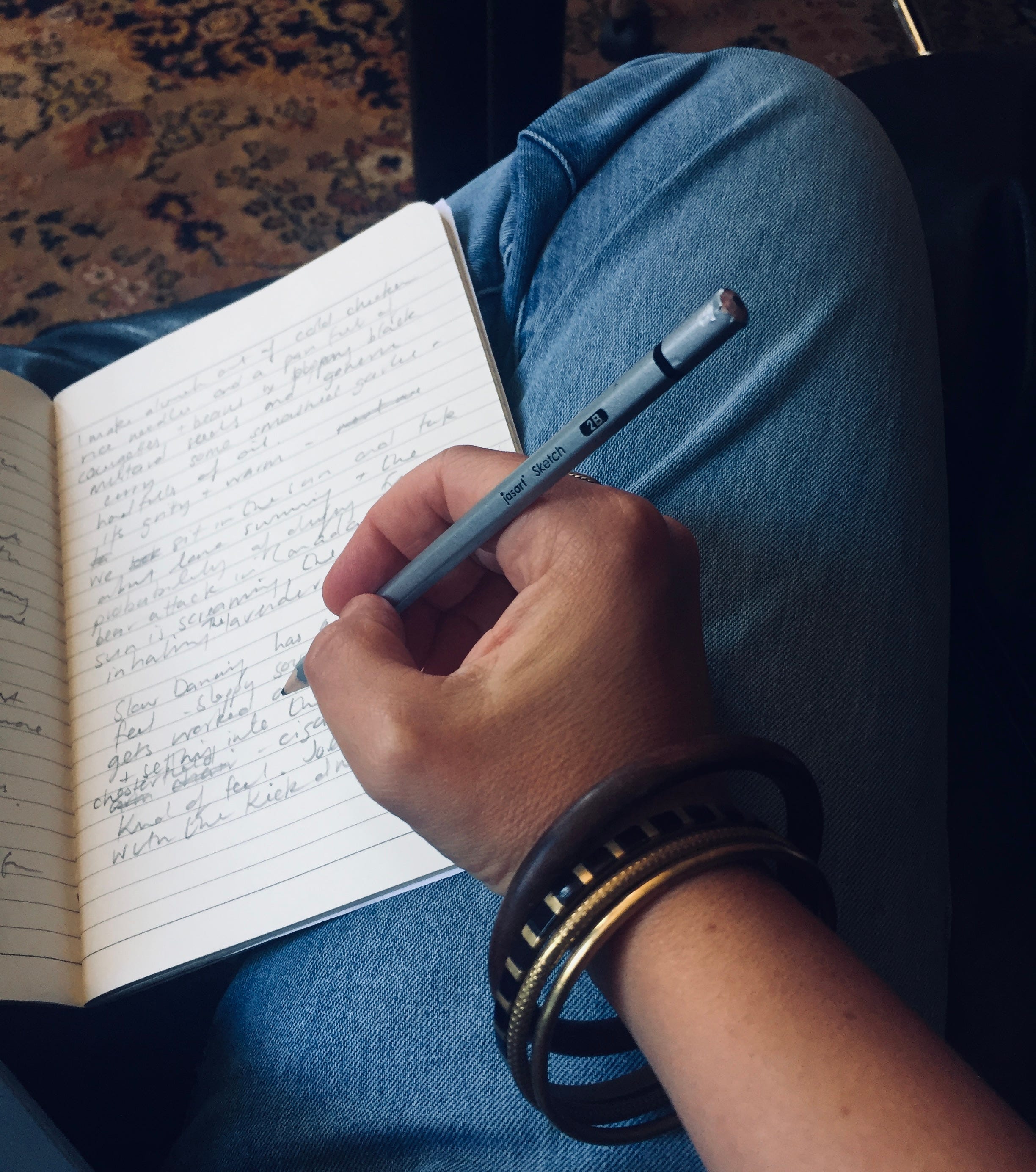
Day #1 16th January 2023
I’m early; Mark is collecting Joe off the Black Cat ferry. I slide in the back door, like a thief. I feel out of place and awkward. Unsure how I should hold my body, I contemplate how I should be found when they come back, like a still life. I try to find a cup to make coffee to appear useful and engaged, and not at all out of place.
I unpack my bag of courgettes, angular and phallic, purple beans, and sprouting pea tendrils—lunch will be cooked and light.
It has a monk-like stillness, a hidden-in-the-forest kind of quiet, smelling of plugholes and clay.
We greet with hugs; I am aware of myself giving warmth. It is genuine, but I also feel it as an outsider orchestrating the feeling’s response. ‘psst, let warmth out now.’
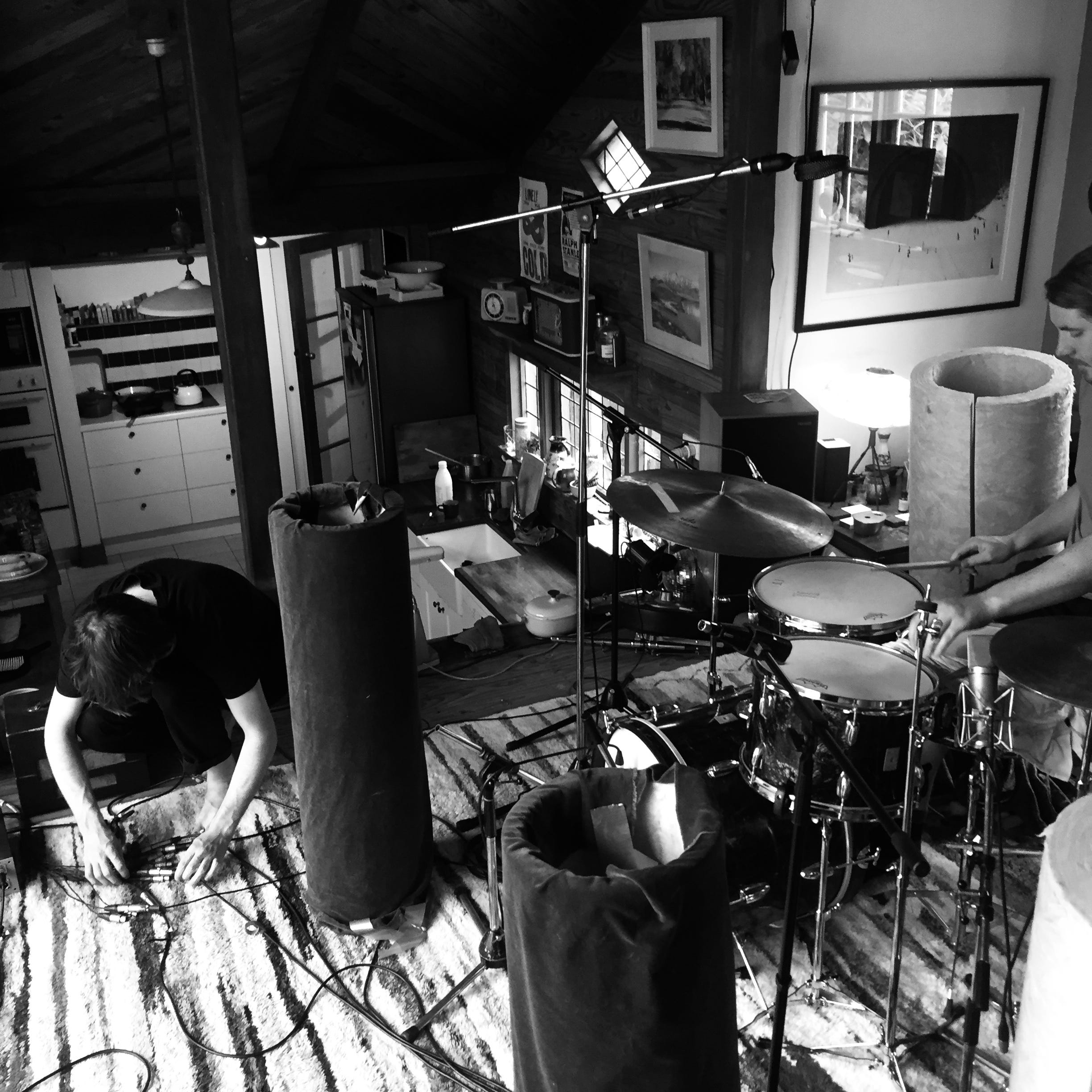
We chat and set up drums. The room is gloomy. We are moving between two levels: a kitchen—you descend steps from outside to enter—and a set of open wooden internal stairs that deliver you up to a main living room floor where we are recording. Vaulted wooden ceilings, like a rural chapel, reach upwards, and arms of light sweep out of a warm conservatory stuck on the front North side. Blocks of sun, parallelograms and rectangles, bolt across the floor. We are the only three living beings in this house.
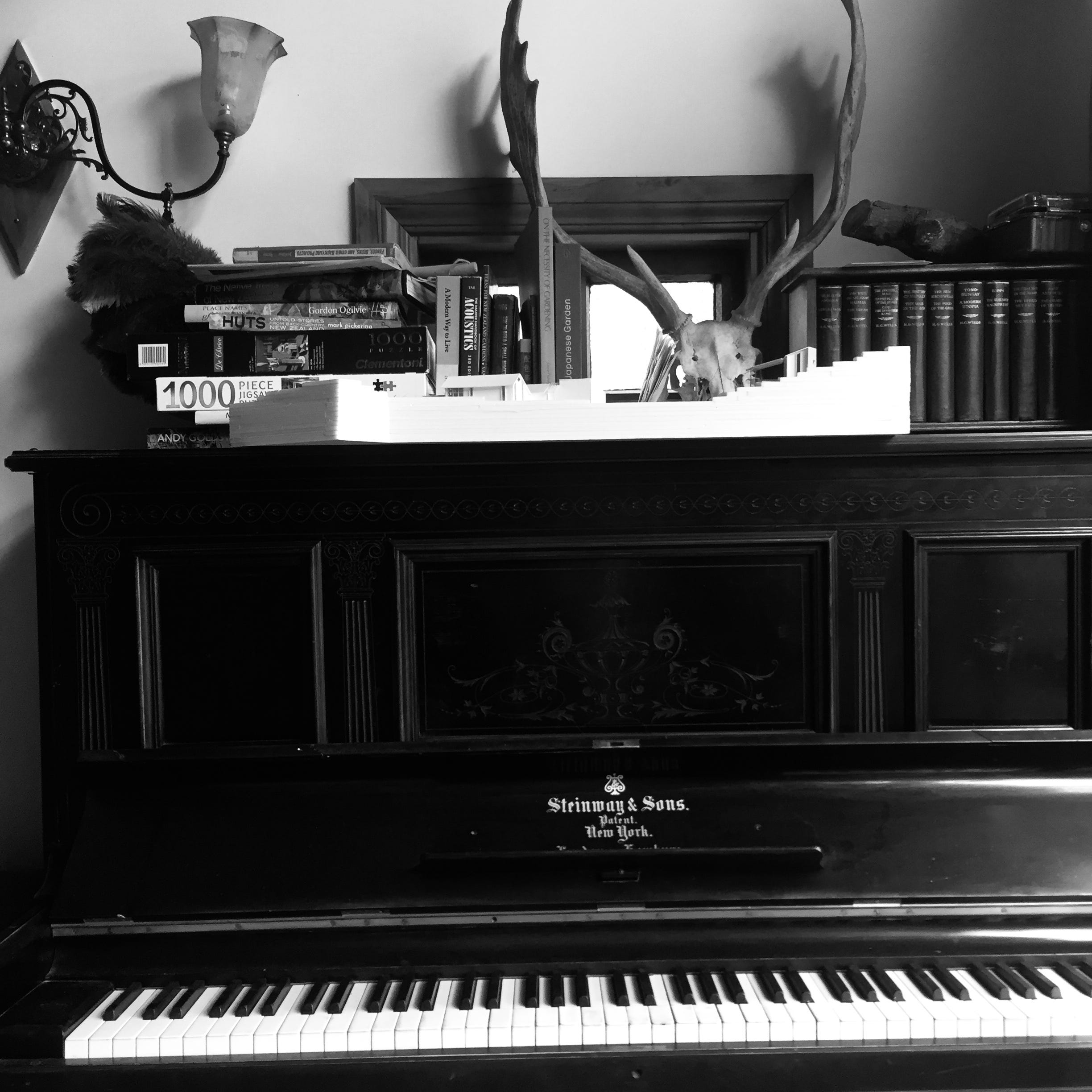
Setting up the drum kit is like prepping the bench for cooking.
In such set-up situations, I feel like a quintessential ‘girl’. It is a thought that has a denigrating undertone in my own mind. It isn’t my drum kit. I don’t know where things should go, how to help, or even how to carry an object—so instead of worrying about offending my friend and carrying it incorrectly, I just sit. In my place as ‘The Artist’ (said in a low whisper), not an engineer, not a drum specialist. I do spend a silly amount of time on these thoughts. But it is not at all odd or sad that I don’t help. It isn’t my job.
We talk about how the lack of sleep will give you dementia, drums made out of the skins of dead bodies, and percussion instruments made out of bones. We macabrely ponder the sound of our friend’s bones as an instrument and what they would sound like. Death leads to the conversation about the writing of wills and protecting our children in the event of our own deaths from landing in the hands of uncaring carers… that will all be taken out of our hands, eventually, surely. In the event.
Cables are plugged into snakes, and webs form across the rug, carrying the sound down the stairs from the landing to a room below, to the left, ending and unfolding its messages into scenes, stems, seams, patterns and light signals.
Joe makes a good noise. The room is punched with an energy it didn’t have before. Mic stands’ arms poke out at angles like a Daniel Libeskind extension. Drumsticks in smooth lines flutter, wading through the air till the air ripples. I imagine it as a 360-degree movement outwards from its centre, through the walls and across the waxy leaves on the trees outside.
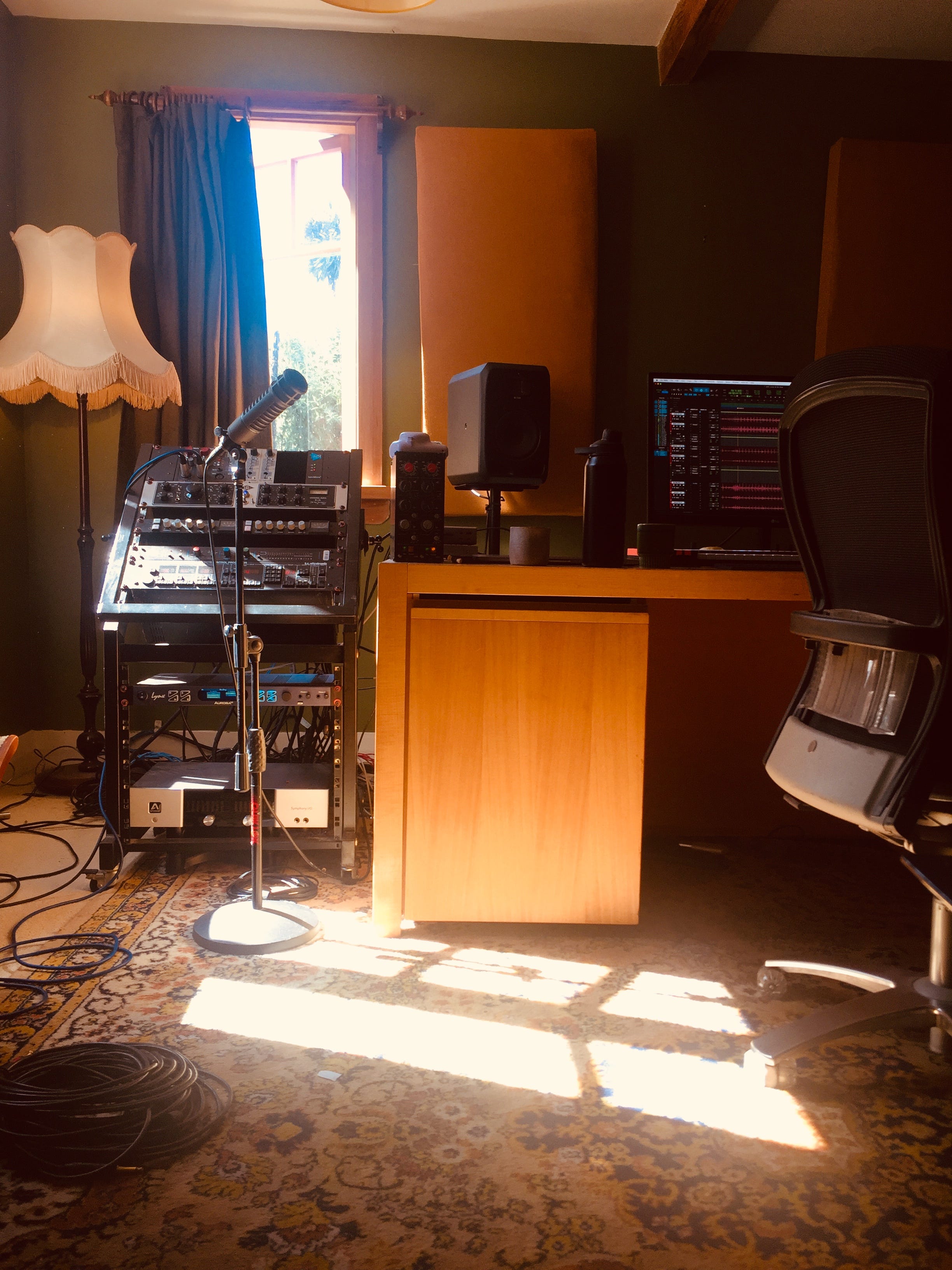
I retreat to the leather sofa in the engineering room; it’s brown-walled and cool; it feels like a rented dorm room. I’ve organised things: a place to put my cup, schedules, and planning sheets. These are nervous tics. There is movement, coming and going around the equipment between our engineering room and the upper chapel. Our engineering room closes with a heavy wooden door; you rush at it with your shoulder to click it. It is decorated on one wall with a cloth hanging, a touring guitar rack with fluffy black insides, a Rhodes, a desk with a computer, pre-amps, and an interface. Speakers sit at the appropriate engineered distance and not facing each other—like strangers, they will speak at the same time, say the same thing, and never acknowledge each other. A stark picture of a half-naked woman with her hands in her lap hangs on another. It angers me. I stare at it uncomprehendingly, mildly vexed. I want to take it off the wall. But it isn’t my house. Why do they always paint women sitting half-naked with their hands in their laps? Any woman I know who is topless is always folding her arms over her body or covering her breasts with cupped hands. At the least, there would be a blur of motion while she finds a covering. What rooms are these people in, where all the women are sanguinely laid back and nude all afternoon? This art does not speak to me. It pokes, and I feel like a prude and embarrassed, and avert my eyes.
There are lights on the panels now, green, red, pulsing and strobing. Sending messages of attack, volume, and tone, these are adjusted and refined to ensure the signal we track is easy to work with and not peaking or blowing out. Like sizzling meat.
I breathe—I sense this foggy dizziness—I push it out of the head; I consciously draw my eye in, locate the solar plexus, and direct the breath downwards to come away from my head and my nervous scanning and assessing of the environment.
It is an act I imagine I will do at least a thousand times today. The nervous scanning and a reverent attempt to regulate myself; I exhale slowly, through the nose.
My challenge here is not just to make a record, but to be aware of myself, remaining connected to my body, and to use that as the internal compass for choices.
I have arrived at my midlife with an awareness that I am disconnected from my physical body. I imagine this is a feeling common for many. And it wasn’t until I was pregnant with my firstborn, at 32, that I realised I wasn’t connected, and worse, I had subjugated my body. When my body entered pregnancy, only then did I notice. Only when another being, parasitically attached, needed my body more, I shushed that voice into something beyond silence and dismissed the needs and opinions of my body. I felt sad at this realisation. For much of my earlier youthful life, I had pushed the sensations and experiences of the physical self out to the edges and centred my experience and assessment of life through the lenses of mental (intellectual, socially perceived norms) and emotional frames.

We are ten years on now. And it is about time I explore what the physical body I dwell in has to say about what I am doing. Through its sensations I can gain intuitive observations.
I know as a singer that when our bodies have become unsafe for us, we cannot execute what we need—we stop playing ball together. We then, either force or push, or we get subdued by the body. I feel myself as a spiritual being inside a physical body, and the body I inhabit also clearly communicates with me.
And I haven’t been listening.
In my life as a singer, I have regained a footing of trust in my body. Yet even with this, I still denied it rest, food, drink, relief, warmth, movement and comfort, and more importantly, love and acceptance.
So I am here to experiment, to say: what happens if I include my whole body? What happens if I include its physical responses in my decisions, too?
We start with “Shake”.